
The 10 Best TVs in 2027
A glossy OLED can mirror every window in a sunny room. We compared 27 expert reviews to pick the best TVs for dark and bright rooms. Find your match.

Affiliate Disclosure: As an Amazon Associate, we may earn a commission from qualifying purchases, and it never changes our picks.
Our picks at a glance
Best TV Overall
LG C6 OLED evo (65-inch, OLED65C6PUA)
Our top pick for most homes. The C6 pairs perfect OLED blacks with about 1,350 to 1,440 nits on HDR highlights, accurate color out of the box and four HDMI 2.1 ports at 4K 165Hz. Finish a console session at 11 p.m. and flip to a Dolby Vision series without swapping a cable. The catch: the glossy screen mirrors windows. Pick 42 to 65 inches on the listing; 77 and 83 are the C6H.
10.0/10Score

$1,299.98 $2,699.99 Save 52%
as of Nov 26, 2026, 23:31 UTC
Best Glare-Free OLED TV
Samsung S90H OLED (65-inch, QN65S90HAEXZA)
For living rooms where daylight lands on the screen. The S90H's matte Glare Free coating nearly erases reflections, HDR highlights reach about 1,500 to 1,690 nits, and four HDMI 2.1 ports run 4K 165Hz. With late sun pouring through a west window, you still see the picture, not yourself. The catch: no Dolby Vision, and blacks lift a little in bright light. Choose 42 to 83 inches on the listing.
9.9/10Score
$1,397.99 $1,897.99 Save 26%
as of Nov 26, 2026, 23:31 UTC
Best Mini LED TV for the Money
TCL QM7L SQD-Mini LED (65-inch, 65QM7L)
The best value here for a big, bright screen. The QM7L's SQD-Mini LED hit about 2,270 nits on a 10% HDR window in Tom's Guide's lab, contrast is deep, and lag sits near 9.4 ms. A snowy mountain documentary at noon in an open-plan room still looks vivid. The catch: reflections show in dark scenes and fast games blur. Check the listing for 55 to 98 inches; the 75 is a sweet spot.
9.6/10Score
$847.99 $1,499.99 Save 43%
as of Nov 26, 2026, 23:31 UTC
Best Movie TV with Built-In Sound
Sony BRAVIA 8 II QD-OLED (65-inch, K-65XR80M2)
For film lovers who want the most natural picture and no soundbar. The Bravia 8 II's QD-OLED has rich, accurate color, the best motion and upscaling on this list, and the screen itself is the speaker. An old HD sitcom on a streaming app looks cleaner than on most TVs. The catch: only two HDMI 2.1 ports, and it's dimmer than rivals. It comes in 55 and 65 inches only.
9.3/10Score
$2,198.00 $3,299.99 Save 33%
as of Nov 26, 2026, 23:31 UTC
Best Value TV for Bright Rooms
Hisense U7SG Mini-LED (65-inch, 65U7SG)
For a sunny room and a full gaming setup on a mid budget. The U7SG pairs a matte screen that nearly erases reflections with about 2,870 nits on HDR highlights, four HDMI 2.1 ports and 165Hz at 4K. A PS5, an Xbox and a gaming PC can all stay plugged in. The catch: fast motion blurs, and the picture fades from the side. Pick from 55 to 116 inches on the listing.
9.3/10Score
$797.99 $1,497.99 Save 47%
as of Nov 26, 2026, 23:31 UTC
Black Friday Deal
Best Cheap TV with Deep Blacks
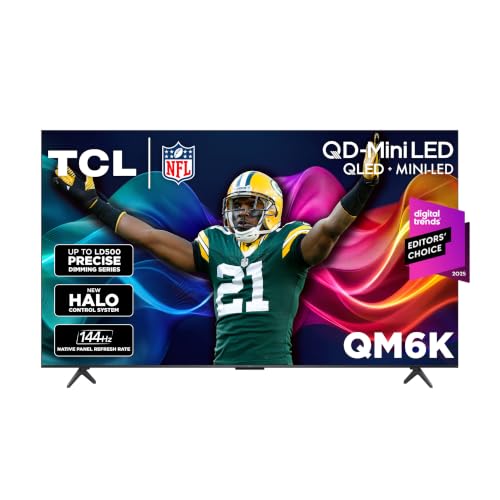
TCL QM6K QD-Mini LED (65-inch, 65QM6K)
Our budget pick for a dim or average living room. The QM6K brings real Mini LED dimming, deep blacks and little blooming, plus 4K 144Hz VRR gaming on two HDMI 2.1 ports. A dark sci-fi series in a basement rec room looks inky, not gray. The catch: HDR highlights lack punch, and screens up to 75 inches are glossy. Sizes run 50 to 98 inches; only the 85 and 98 are matte.
8.8/10Score
$597.99 $799.99 Save 25%
as of Nov 26, 2026, 23:31 UTC
Best Big-Screen TV up to 98 Inches
TCL QM8L SQD-Mini LED (65-inch, 65QM8L)
For a really big screen in a lit room. The QM8L comes in 65 to 98 inches, measured about 3,700 nits on a 10% HDR window, and keeps blacks deep with little blooming. An 85-inch across a great room stays punchy with the blinds half open. The catch: reflections and a rainbow smear remain visible. Pick your size on the listing; the 85 and 98 make it a true wall of picture.
8.7/10Score
$997.99 $2,499.99 Save 60%
as of Nov 26, 2026, 23:31 UTC
Best Entry OLED TV for Gamers
LG B6 OLED (65-inch, OLED65B6GUA)
The cheapest way into LG OLED with the full gaming kit. The B6 keeps perfect blacks, very accurate color and four HDMI 2.1 ports at 4K 120Hz with about 9 ms of lag. In a spare room with blackout curtains, it looks close to the C6. The catch: HDR peaks near 700 to 835 nits, so daylight washes it out. Pick 65, 77 or 83 inches on the listing; the 55 was hard to find in the US.
8.5/10Score
$1,199.99 $1,999.99 Save 40%
as of Nov 26, 2026, 23:31 UTC
Best Last-Gen TV for Bright HDR
Hisense U8QG Mini-LED ULED (65-inch, 65U8QG)
Last year's Hisense flagship, still sold new and still one of the brightest TVs for the money. The U8QG measured about 3,337 to 3,800 nits on a 10% HDR window, has superb contrast, and its USB-C input takes a laptop. An HDR concert film on a sunny afternoon stays punchy. The catch: average motion, a rattly sub and reports of panel defects. Check sizes from 55 to 100 inches.
8.4/10Score
$899.99 $1,097.97 Save 18%
as of Nov 26, 2026, 23:31 UTC
Black Friday Deal
Best Easy-to-Use OLED TV
Roku Pro Series OLED (65-inch, 2026)
For anyone who wants OLED with the simplest menus. Roku's Pro Series pairs perfect blacks and a wide viewing angle with Roku OS, a backlit voice remote and a button on the TV that makes a lost remote beep. A late show through Bluetooth headphones won't wake the house. The catch: dim HDR and muffled speakers. It comes in 55 or 65 inches; pick yours on the listing.
8.1/10Score
$799.99 $1,199.99 Save 33%
as of Nov 26, 2026, 23:31 UTC
Black Friday Deal
Product prices and availability are accurate as of the date/time indicated and are subject to change. Any price and availability information displayed on Amazon.com at the time of purchase will apply to the purchase of this product.
How we rank best TVs for you?
We weigh picture quality first: contrast, color and HDR, because that's what you see every single night. Brightness and glare come next, since a sunny room can wash out a great panel and the right screen finish fixes it. Value follows, because mid-range sets now get you most of the way to flagship picture. Gaming and motion matter for consoles and fast action, so we count full HDMI 2.1 ports and look at blur. Design and build round it out: stands, ports, remotes and sound. That puts the LG C6 first.
Picture Quality30%
Contrast, color accuracy and HDR highlights decide how every film, show and game looks on the screen you'll stare at for years.
Brightness and Glare25%
A window or lamp facing the TV can turn a great panel gray, so brightness and the screen finish have to suit your room.
Value20%
The extra money should buy picture you can actually see from your sofa, not features you'll never switch on.
Gaming and Motion15%
Full-speed HDMI 2.1 ports, low lag and clean motion keep consoles, PCs and fast camera pans looking sharp.
Design and Build10%
Stand width, port placement, the remote and built-in sound shape how easy the TV is to live with every day.
Best TVs compared
Swipe sideways to see every spec.
| Product | Score | Panel | Sizes | Refresh Rate | HDR |
|---|---|---|---|---|---|
| 10.0 | WOLED, glossy (77 and 83 in are the C6H with RGB tandem OLED) | 42, 48, 55, 65 in (C6); 77, 83 in (C6H) | 165Hz native, 4K 165Hz on all four HDMI 2.1 ports | Dolby Vision, HDR10, HLG (no HDR10+) | |
| 9.9 | WOLED, matte Glare Free (48 and 77 in use RGB tandem OLED) | 42, 48, 55, 65, 77, 83 in | 165Hz native, 4K 165Hz on all four HDMI 2.1 ports | HDR10, HDR10+ (no Dolby Vision) | |
| 9.6 | SQD-Mini LED, HVA 2.0 Pro panel, up to 2,100+ zones | 55, 65, 75, 85 and 98 inches | 144Hz native; 2 of 4 HDMI ports are HDMI 2.1 | Dolby Vision, HDR10+, HDR10, HLG | |
| 9.3 | QD-OLED, glossy with strong anti-reflection layer | 55, 65 in | 120Hz native, 4K 120Hz on 2 of 4 HDMI ports | Dolby Vision, HDR10, HLG, IMAX Enhanced | |
| 9.3 | Mini-LED VA LCD, full-array dimming, matte anti-glare screen | 55, 65, 75, 85, 100, 116 inches | 165Hz native at 4K, 330Hz at 1080p, 4x HDMI 2.1 | Dolby Vision, HDR10+, HDR10+ Adaptive, HDR10, HLG | |
| 8.8 | QD-Mini LED LCD, full-array local dimming (500 zones at 65in) | 50, 55, 65, 75, 85, 98 inches | 120Hz native, 144Hz VRR (2x HDMI 2.1), 288Hz at 1080p | Dolby Vision IQ, HDR10+, HDR10, HLG | |
| 8.7 | SQD-Mini LED, WHVA 2.0 Ultra VA, up to 4,000 zones | 65, 75, 85 and 98 inches | 144Hz native, 4x HDMI 2.1, VRR 48-288Hz | Dolby Vision IQ, HDR10+, HDR10, HLG | |
| 8.5 | WOLED (LG 'OLED SE' panel), glossy | 48, 55, 65, 77, 83 in | 120Hz native, 4K 120Hz on all four HDMI 2.1 ports | Dolby Vision, HDR10, HLG (no HDR10+) | |
| 8.4 | Mini LED ULED QLED, Anti-Reflection Pro screen | 55, 65, 75, 85 and 100 inches | 165Hz native; 1080p 288Hz; 3x HDMI 2.1 plus USB-C | Dolby Vision IQ, HDR10+, HDR10, HLG | |
| 8.1 | 4K WOLED (LG Display 'OLED SE' panel, per RTINGS) | 55, 65 in | 120Hz with VRR, FreeSync Premium and ALLM | Dolby Vision, HDR10+, HLG |
1. LG C6 OLED evo (65-inch, OLED65C6PUA): Best TV Overall

- Picture Quality
- 9.6
- Brightness and Glare
- 8.4
- Value
- 8.7
- Gaming and Motion
- 9.7
- Design and Build
- 8.9
$1,299.98 $2,699.99 Save 52%
as of Nov 26, 2026, 23:31 UTC
Key specs 5
- Panel
- WOLED, glossy (77 and 83 in are the C6H with RGB tandem OLED)
- Sizes
- 42, 48, 55, 65 in (C6); 77, 83 in (C6H)
- Refresh Rate
- 165Hz native, 4K 165Hz on all four HDMI 2.1 ports
- HDR
- Dolby Vision, HDR10, HLG (no HDR10+)
- Smart OS
- LG webOS 26, at least four years of webOS updates
If you want one TV that handles films, streaming and gaming with no weak spot, get the C6. It has the perfect blacks OLED is known for, about 1,350 to 1,440 nits on small HDR highlights, and a Filmmaker Mode that looks close to calibrated straight from the box. TechRadar measured a Delta-E of 1.2, about as accurate as TVs get.
Picture a living room with a PS5 and a gaming PC both plugged in. You wrap up a 120Hz session at 11 p.m., then switch to a Dolby Vision series, and nothing needs re-cabling because all four HDMI 2.1 ports run up to 4K 165Hz. The Magic Remote has a pointer, voice and a programmable button, and LG promises at least four years of webOS updates.
The real downside is glare: the glossy screen mirrors a window across the room, and the speakers are thin. The 77 and 83-inch sizes are the C6H, a different panel, and several C6H owners on AVForums report faint banding in near-black scenes. So would we buy it? For a dim or average room, yes. Sun on the screen? The Samsung S90H (#2) fixes that.
Best for: Most buyers with a dim or moderately lit room who watch films and play on a console or PC.
Skip it if: Your screen faces a bright window. The Samsung S90H (#2) has a matte screen that nearly erases reflections.
Pros
- About 1,350 to 1,440 nits HDR on a 10% window
- Near-perfect color accuracy out of the box
- 4K 165Hz, VRR and Dolby Vision gaming on 4 HDMI 2.1
- Very low input lag, about 9 ms at 60Hz
Cons
- Glossy screen shows mirror-like reflections
- Weak built-in sound, plan on a soundbar
- 77 and 83 in are a different model (C6H)
Hands-on reviews behind this pick
- RTINGS
Show the verdict
Lab-tested with excellent HDR highlights, perfect blacks and superb accuracy, but only okay direct-reflection handling, so bright rooms and sports with big bright areas look dimmer.
- Tom's Guide
Show the verdict
A 65-inch measured 1,355 nits HDR and 9.1 ms lag; a near-flawless mid-range OLED with great gaming and a better Magic Remote, though only a small step over the C5.
- TechRadar
Show the verdict
Brighter and more accurate than the C5 at 1,438 nits and Delta-E 1.2, a best-in-class gaming TV with 4K 165Hz, held back by a reflective screen in bright rooms.
2. Samsung S90H OLED (65-inch, QN65S90HAEXZA): Best Glare-Free OLED TV

- Picture Quality
- 9.2
- Brightness and Glare
- 9.2
- Value
- 8.2
- Gaming and Motion
- 9.4
- Design and Build
- 8.6
$1,397.99 $1,897.99 Save 26%
as of Nov 26, 2026, 23:31 UTC
Key specs 5
- Panel
- WOLED, matte Glare Free (48 and 77 in use RGB tandem OLED)
- Sizes
- 42, 48, 55, 65, 77, 83 in
- Refresh Rate
- 165Hz native, 4K 165Hz on all four HDMI 2.1 ports
- HDR
- HDR10, HDR10+ (no Dolby Vision)
- Smart OS
- Samsung Tizen (One UI), 7 years of OS updates
Love OLED but your room is bright? This is the one. At most sizes the S90H uses the same kind of WOLED panel as the C6, then adds a matte Glare Free coating that nearly wipes out reflections. HDR highlights measured about 1,500 to 1,690 nits, and gaming is just as strong: four HDMI 2.1 ports, 4K 165Hz and about 9 ms of lag.
Say your sofa faces a west window and the late-afternoon sun lands right on the TV. On a glossy screen you'd see your own reflection; here you see the show. It also removes judder from 24p films. The remote charges by solar or USB-C, and you'll need a Samsung account before the built-in apps work.
Here's what you give up. There's no Dolby Vision, the matte layer lifts blacks slightly with the lights on, and TechRadar saw some black crush in dark scenes. RTINGS reports the 48 and 77-inch get an RGB tandem panel, but Samsung doesn't disclose it. So would we buy it? For a sunny room, yes, and there are more TVs bright enough for a sunny living room if you want options. Watch mostly after dark? The LG C6 (#1) adds Dolby Vision.
Best for: Bright living rooms with windows or overhead lights, and gamers who want OLED with four full HDMI 2.1 ports.
Skip it if: You collect Dolby Vision films and watch in the dark. The LG C6 (#1) supports Dolby Vision and has a glossy screen built for dim rooms.
Pros
- Matte screen nearly erases reflections
- About 1,500 to 1,690 nits on HDR highlights
- 4K 165Hz, VRR and about 9 ms input lag
- Wide viewing angle, judder-free 24p
Cons
- No Dolby Vision
- Blacks look a little lifted in bright light
- Panel type changes by size
Hands-on reviews behind this pick
- RTINGS
Show the verdict
Its matte coating does an outstanding job with direct reflections, making it a much better bright-room pick than the S85H, with perfect contrast and 165Hz gaming but no Dolby Vision.
- TechRadar
Show the verdict
An excellent mid-range OLED that stays great in a bright room thanks to an effective anti-glare screen, with 1,689 nits and 9.2 ms lag; a worthy LG C6 rival despite some black crush.
- Tom's Guide
Show the verdict
A great glare-free OLED for the money: a 55-inch hit 1,497 nits HDR with Delta-E 1.65 and fuller 40W sound, though the cheaper S85H comes close in picture quality.
3. TCL QM7L SQD-Mini LED (65-inch, 65QM7L): Best Mini LED TV for the Money

- Picture Quality
- 8.7
- Brightness and Glare
- 8.9
- Value
- 9.5
- Gaming and Motion
- 8.4
- Design and Build
- 8.0
$847.99 $1,499.99 Save 43%
as of Nov 26, 2026, 23:31 UTC
Key specs 5
- Panel
- SQD-Mini LED, HVA 2.0 Pro panel, up to 2,100+ zones
- Sizes
- 55, 65, 75, 85 and 98 inches
- Refresh Rate
- 144Hz native; 2 of 4 HDMI ports are HDMI 2.1
- HDR
- Dolby Vision, HDR10+, HDR10, HLG
- Smart OS
- Google TV 14 with Gemini
Here's where value gets serious. The QM7L gives you most of what pricier Mini LED sets do: Tom's Guide measured about 2,270 nits on a 10% HDR window, local dimming keeps blacks deep, and it plays Dolby Vision and HDR10+. For a big family room, it's the set we'd point most budgets to.
Imagine an open-plan room at noon, kitchen lights on, with a snowy mountain documentary on a 75-inch. It stays vivid instead of washed out. Gaming is solid too: 4K 144Hz with VRR and about 9.4 ms of lag on HDMI 1 and 2. Google TV with Gemini runs the apps, and the backlit voice remote has streaming shortcut buttons.
Now the catches. Reflections are only partly tamed, so a lamp opposite shows in dark scenes, fast games blur, and colors fade from the sides. Owners on AVS Forum keep reporting judder in 30fps console games, even as firmware updates improve the picture. So would we buy it? For a bright room on a mid budget, yes. Big sectional sofa? The LG C6 (#1) holds its color off to the side.
Best for: Value buyers who want a bright, high-contrast screen at 55 to 98 inches for a family room with moderate light.
Skip it if: You have three or four HDMI 2.1 devices. The Hisense U7SG (#5) gives you four full ports.
Pros
- Bright enough for well-lit rooms and day sports
- Deep contrast with modest haloing
- Very low input lag, 144Hz and VRR
- Great value for SQD Mini LED
- Easy Google TV with Gemini
Cons
- Reflections still visible in dark scenes
- Mediocre viewing angle
- Blurry motion in fast games
- Only two HDMI 2.1 ports; Wi-Fi 5
Hands-on reviews behind this pick
- RTINGS
Show the verdict
A bright, high-contrast mid-range Mini LED with excellent color volume and a full gaming feature set; HDR runs too bright and cool out of the box, reflections linger and fast motion blurs.
- Tom's Guide
Show the verdict
Resets what an affordable big TV should deliver: bright, vibrant SQD picture, very good accuracy (Delta-E 2.64), 9.4 ms input lag and barely visible blooming; Wi-Fi 5 is the main dated spec.
4. Sony BRAVIA 8 II QD-OLED (65-inch, K-65XR80M2): Best Movie TV with Built-In Sound

- Picture Quality
- 9.7
- Brightness and Glare
- 8.0
- Value
- 7.8
- Gaming and Motion
- 8.0
- Design and Build
- 9.2
$2,198.00 $3,299.99 Save 33%
as of Nov 26, 2026, 23:31 UTC
Key specs 5
- Panel
- QD-OLED, glossy with strong anti-reflection layer
- Sizes
- 55, 65 in
- Refresh Rate
- 120Hz native, 4K 120Hz on 2 of 4 HDMI ports
- HDR
- Dolby Vision, HDR10, HLG, IMAX Enhanced
- Smart OS
- Google TV (with Gemini), Google voice and AirPlay 2
If films matter more to you than anything else, the Bravia 8 II is the one we'd buy. Its QD-OLED panel has rich yet accurate color, and Sony's processing gives it the best motion, upscaling and low bit-rate handling on this list. HDTVTest measured close to 1,700 nits on a 10% window after calibration.
Picture a Friday night with a 4K Blu-ray of a slow-panning western. The landscape glides without judder, and the dialogue comes from the screen itself through Acoustic Surface Audio+, so voices sit right on the actors. It also tidies up older shows streamed in low quality. AirPlay 2 and Google Cast are built in, and a PS5 gets its own HDR tone mapping.
But it's not for every room. It's dimmer than LG and Samsung rivals, blacks go gray under direct light, there are only two HDMI 2.1 ports, and the remote isn't backlit. The feet sit at the outer edges, so you'll need a wide stand. So would we buy it? For a dim room and a big film collection, yes. Running two consoles plus a soundbar? The LG C6 (#1) has four full ports.
Best for: Movie fans in a dim or moderately lit room who value accurate color, smooth motion and good sound without a soundbar.
Skip it if: You need a 75-inch or bigger screen, or a very bright room. The TCL QM8L (#7) goes up to 98 inches and gets far brighter.
Pros
- Superb motion, upscaling and low-bit-rate handling
- Accurate, rich QD-OLED color and wide viewing angle
- Screen-as-speaker sound beats most TVs
- Removes 24p judder from any source (RTINGS)
Cons
- Only two HDMI 2.1 ports, one shared with eARC
- Dimmer than Samsung and LG flagships
- No 77-inch size; remote not backlit
Hands-on reviews behind this pick
- RTINGS
Show the verdict
Impressive HDR highlights, superb upscaling and judder-free 24p from any source, but only two full HDMI 2.1 ports, no 1440p, dimmer than the S95F and blacks turn gray in a bright room.
- TechRadar
Show the verdict
Brighter than the Bravia 8, with rich yet accurate color, an effective anti-reflective screen and built-in sound a notch above most TVs, but gaming features trail rival flagships.
- What Hi-Fi?
Show the verdict
An extraordinarily good 55-inch QD-OLED with piercing, detailed HDR highlights and exceptional tone mapping, let down by only two full HDMI 2.1 sockets and a downgraded, unlit remote.
5. Hisense U7SG Mini-LED (65-inch, 65U7SG): Best Value TV for Bright Rooms

- Picture Quality
- 8.1
- Brightness and Glare
- 9.1
- Value
- 9.2
- Gaming and Motion
- 8.4
- Design and Build
- 7.6
$797.99 $1,497.99 Save 47%
as of Nov 26, 2026, 23:31 UTC
Black Friday Deal
Key specs 5
- Panel
- Mini-LED VA LCD, full-array dimming, matte anti-glare screen
- Sizes
- 55, 65, 75, 85, 100, 116 inches
- Refresh Rate
- 165Hz native at 4K, 330Hz at 1080p, 4x HDMI 2.1
- HDR
- Dolby Vision, HDR10+, HDR10+ Adaptive, HDR10, HLG
- Smart OS
- Google TV with hands-free Gemini (U7SF: Fire TV)
The U7SG is the value pick for a bright room, and gamers get the most for their money here too. It's the first standard Hisense with a matte coating, which makes windows and lamps barely visible, and both TechRadar and Tom's Guide measured about 2,866 nits on a 10% HDR window.
Here's the setup it suits: a sunroom-style den with glass on two sides, and a PS5, an Xbox and a gaming PC all connected at once. Four HDMI 2.1 ports run 4K at 165Hz, so nothing gets unplugged, and Tom's Guide measured 9.8 ms of lag. The 2.1.2 speakers include a sub, so it sounds fuller than most sets, and an ATSC 3.0 tuner picks up over-the-air channels.
The trade-offs show in fast scenes. Motion blurs, VRR can flicker at lower frame rates, and the VA panel fades off-angle. Filmmaker Mode SDR is dim at about 185 nits, so daytime means a brighter preset. So would we buy it? For a bright game room, yes. Want OLED blacks with a matte screen? The Samsung S90H (#2) has both.
Best for: Gamers and families with a bright room who want a matte screen and four HDMI 2.1 ports on a mid budget.
Skip it if: Your seating is wide or you notice motion blur. The Samsung S90H (#2) has a wide viewing angle and OLED motion.
Pros
- Very bright HDR: about 2,870 nits measured at 10%
- Matte screen tames lamps and windows
- Four HDMI 2.1 ports, 165Hz and very low lag
- Full sound with a built-in subwoofer
Cons
- Dim Filmmaker-mode SDR (about 185 nits)
- Motion blur and VRR flicker in fast scenes
- Narrow viewing angle from its VA panel
Hands-on reviews behind this pick
- RTINGS
Show the verdict
Lab-tested as excellent in HDR and SDR brightness with excellent contrast and a matte coating that nearly erases reflections; motion is blurry and VRR flickers at lower frame rates.
- TechRadar
Show the verdict
A 65-inch Google TV unit hit 2,866 nits HDR; one of 2026's best values for movies and gaming, with good sound, but some color bleed, vignetting and slightly lower accuracy.
- Tom's Guide
Show the verdict
Tested at 65 inches: great color, powerful sound and 9.8 ms input lag, but blacks and shadows never got dark enough, so HDR trails the best in its class.
6. TCL QM6K QD-Mini LED (65-inch, 65QM6K): Best Cheap TV with Deep Blacks
- Picture Quality
- 8.2
- Brightness and Glare
- 7.6
- Value
- 9.7
- Gaming and Motion
- 8.3
- Design and Build
- 7.5
$597.99 $799.99 Save 25%
as of Nov 26, 2026, 23:31 UTC
Key specs 5
- Panel
- QD-Mini LED LCD, full-array local dimming (500 zones at 65in)
- Sizes
- 50, 55, 65, 75, 85, 98 inches
- Refresh Rate
- 120Hz native, 144Hz VRR (2x HDMI 2.1), 288Hz at 1080p
- HDR
- Dolby Vision IQ, HDR10+, HDR10, HLG
- Smart OS
- Google TV with hands-free Google Assistant
On a tight budget, this is the TV we'd buy. The QM6K is a 2025 model still sold new, and it's a big step up from basic LED sets because real Mini LED dimming keeps blacks deep with little blooming. Color is accurate in Filmmaker and Movie modes without any fiddling.
Say your TV lives in a basement rec room with one small window. A dark sci-fi series looks inky rather than gray, and starfields don't glow with halos. It copes with daylight in SDR too: Tom's Guide measured 688 nits and found it looked great in a sunny office. Two HDMI 2.1 ports handle a PS5 and an Xbox at 4K 144Hz, with eARC on its own port.
Know the limits. HDR highlights peak around 560 to 700 nits, the 50 to 75-inch screens are glossy, viewing angles are narrow, and Google TV shows ads you can't turn off. There's no ATSC 3.0 tuner either. So would we buy it? For a dim room on a budget, yes, and we round up more great TVs that don't cost a fortune too. Need more brightness? The TCL QM7L (#3) is the step up.
Best for: Budget buyers who want Mini LED contrast at 55 to 75 inches for a dim or moderately lit room.
Skip it if: A window or lamp faces your TV. The Hisense U7SG (#5) has a matte screen and far more brightness.
Pros
- Deep blacks and strong contrast for the price
- Little blooming thanks to Halo Control dimming
- 4K 144Hz gaming with VRR and Dolby Vision gaming
- Accurate color in Filmmaker and Movie modes
Cons
- HDR highlights lack punch next to brighter rivals
- Glossy screen shows lamps and windows (to 75in)
- Narrow viewing angle and some motion blur
Hands-on reviews behind this pick
- RTINGS
Show the verdict
Lab-measured as a big contrast step for a budget set: deep blacks and decent dimming, but mediocre real-scene HDR brightness, a glossy screen and a narrow viewing angle.
- TechRadar
Show the verdict
A 65-inch unit tested at about 560 to 695 nits HDR: vibrant, low-blooming picture and easy Google TV, held back by slight corner vignetting and boxy sound.
- Tom's Guide
Show the verdict
A purchased 55-inch measured 688 nits in SDR and looked great in a sunny office; great value overall, though 13.1 ms input lag and uneven sound hold it back.
7. TCL QM8L SQD-Mini LED (65-inch, 65QM8L): Best Big-Screen TV up to 98 Inches

- Picture Quality
- 8.5
- Brightness and Glare
- 8.4
- Value
- 7.6
- Gaming and Motion
- 8.5
- Design and Build
- 8.0
$997.99 $2,499.99 Save 60%
as of Nov 26, 2026, 23:31 UTC
Key specs 5
- Panel
- SQD-Mini LED, WHVA 2.0 Ultra VA, up to 4,000 zones
- Sizes
- 65, 75, 85 and 98 inches
- Refresh Rate
- 144Hz native, 4x HDMI 2.1, VRR 48-288Hz
- HDR
- Dolby Vision IQ, HDR10+, HDR10, HLG
- Smart OS
- Google TV 14 with Gemini
Going big? The QM8L is the TV we'd hang on a large wall. It starts at 65 inches and runs to 98, and it's one of the brightest TVs at its price: Tom's Guide measured 3,719 nits on a 10% HDR window. Local dimming keeps blacks deep with little blooming, and upscaling cleans up streams well.
Picture an 85-inch across a great room, the sofa a long way back, and a bright animated film on with the blinds half open. The brightness cuts through, and four HDMI 2.1 ports at 4K 144Hz give every console a home. It also has an ATSC 3.0 tuner, Wi-Fi 6 and a backlit voice remote. Still measuring the wall? Compare the best big screens at 75 inches first.
The weak spots are glare and angles. Reflections stay visible with a rainbow smear, colors fade from the sides, and fast games blur. AVS Forum owners say firmware keeps improving it, but judder in 30fps games lingers. So would we buy it? For a huge, bright screen, yes. Want most of this for less? The TCL QM7L (#3).
Best for: Big-screen buyers at 75 to 98 inches with a bright room and indirect light who want four HDMI 2.1 ports.
Skip it if: Windows face the screen directly. The Hisense U7SG (#5) has a matte coating that hides reflections.
Pros
- Very bright: about 3,700 nits on a 10% HDR window
- Deep blacks with little blooming
- Four HDMI 2.1 ports and very low input lag
- Strong upscaling and stream cleanup
- Slim-bezel pedestal design
Cons
- Reflections stay clearly visible, with rainbow smear
- Mediocre viewing angle
- Blurry fast motion when gaming
- Out-of-box color accuracy lags rivals
Hands-on reviews behind this pick
- RTINGS
Show the verdict
An incredibly bright, high-contrast Mini LED with excellent color volume, upscaling and gaming features, let down by just okay reflection handling, a mediocre viewing angle and blurry fast motion.
- Tom's Guide
Show the verdict
Pushes LCD close to OLED with deep, detailed blacks, powerful HDR and brightness that holds up in well-lit rooms, measuring 3,719 nits, but Filmmaker-mode color accuracy is among the weakest tested.
8. LG B6 OLED (65-inch, OLED65B6GUA): Best Entry OLED TV for Gamers

- Picture Quality
- 8.7
- Brightness and Glare
- 6.8
- Value
- 8.4
- Gaming and Motion
- 9.0
- Design and Build
- 7.6
$1,199.99 $1,999.99 Save 40%
as of Nov 26, 2026, 23:31 UTC
Key specs 5
- Panel
- WOLED (LG 'OLED SE' panel), glossy
- Sizes
- 48, 55, 65, 77, 83 in
- Refresh Rate
- 120Hz native, 4K 120Hz on all four HDMI 2.1 ports
- HDR
- Dolby Vision, HDR10, HLG (no HDR10+)
- Smart OS
- LG webOS 26 with Magic Remote
Want OLED without paying for the C6? The B6 is our pick. In a dim room it looks close to its pricier sibling, with perfect blacks and color accurate enough that you can skip calibration. Gaming is the same story: four HDMI 2.1 ports, 4K 120Hz, VRR and about 9 ms of lag.
Picture a spare room turned media room, blackout curtains drawn, a controller on the arm of the chair. Dark game levels show every shadow, and the wide viewing angle means a friend on the floor sees the same picture. Tom's Guide measured better SDR accuracy than the C6, and RTINGS found it smooths low-quality streams better than rivals.
The gap is brightness. Tom's Guide measured 695 nits on a 10% HDR window against 1,251 for the C6, so daytime viewing needs a brighter mode, and the glossy screen reflects lamps. Sound is a thin 20W, the plastic feet feel flimsy, and two HDMI ports face straight back, awkward on a flat wall mount. So would we buy it? For a dark room, yes. Room gets sun? Step up to the LG C6 (#1).
Best for: First-time OLED buyers and gamers with a dim room who want four HDMI 2.1 ports for less.
Skip it if: Your room gets daytime sun. The Samsung S90H (#2) is brighter and has a matte screen.
Pros
- OLED contrast and gaming features for less than the C6
- Very accurate color out of the box
- Four HDMI 2.1 ports, about 9 ms input lag
- Wide viewing angle for a big sofa
Cons
- About 700 to 835 nits HDR, dimmer than the C6
- Glossy screen struggles in bright rooms
- Thin sound and plastic feet
Hands-on reviews behind this pick
- RTINGS
Show the verdict
Perfect contrast, fantastic HDR accuracy and smoother low-quality streams than rivals, but only decent HDR and mediocre SDR brightness plus a glossy screen suit dim rooms.
- Tom's Guide
Show the verdict
Nearly as good as the C6 for much less: 695 nits HDR against the C6's 1,251, but better SDR color accuracy, 8.9 ms input lag and the same gaming features; the feet feel flimsy.
- TechRadar
Show the verdict
A great entry OLED with superb gaming and a big brightness jump to 835 nits, but a stronger green tint than the B5, reflections and narrow sound make it less of an upgrade.
9. Hisense U8QG Mini-LED ULED (65-inch, 65U8QG): Best Last-Gen TV for Bright HDR

- Picture Quality
- 8.2
- Brightness and Glare
- 8.4
- Value
- 7.6
- Gaming and Motion
- 8.5
- Design and Build
- 6.8
$899.99 $1,097.97 Save 18%
as of Nov 26, 2026, 23:31 UTC
Black Friday Deal
Key specs 5
- Panel
- Mini LED ULED QLED, Anti-Reflection Pro screen
- Sizes
- 55, 65, 75, 85 and 100 inches
- Refresh Rate
- 165Hz native; 1080p 288Hz; 3x HDMI 2.1 plus USB-C
- HDR
- Dolby Vision IQ, HDR10+, HDR10, HLG
- Smart OS
- Google TV
Is last year's model worth it? Here, yes. The U8QG is a 2025 set with no 2026 U8 to replace it in the US, and it's still one of the brightest TVs for the money: TechRadar measured 3,337 nits on a 10% HDR window, and contrast gets close to OLED with little blooming.
Say you put on an HDR concert film on a sunny weekend afternoon. The stage lights cut through, and the Anti-Reflection Pro screen tames glare from overhead lights. A USB-C input with DisplayPort takes a laptop for holiday photos or PC games, and three HDMI 2.1 ports run 4K 165Hz. A backlit voice remote and a pedestal stand come with it.
Then the catches. HDR runs brighter than the creator intended, motion is average, and the built-in sub rattles on deep bass. Owners on AVS Forum describe a panel lottery, with banding on some units, so look over yours in the first days. So would we buy it? If you'll check it early, yes. Want a matte screen and four HDMI 2.1 ports instead? The Hisense U7SG (#5).
Best for: Bright-room HDR and gaming fans on a mid budget who want maximum brightness and a USB-C input.
Skip it if: You want accurate HDR without tweaking settings. The LG C6 (#1) looks close to calibrated out of the box.
Pros
- Exceptionally bright, highlights past 4,000 nits
- Superb contrast with minimal blooming
- 165Hz gaming, VRR and very low input lag
- Strong bright-room picture with anti-reflection
- Big 4.1.2 Atmos speaker system
Cons
- HDR runs brighter than the creator intended
- Built-in subwoofer rattles on heavy bass
- Average motion handling, blur trails in sports
- Panel lottery: owners report banding and dark spots
Hands-on reviews behind this pick
- RTINGS
Show the verdict
Exceptionally bright with superb, near-OLED contrast and outstanding HDR color, plus a deep gaming spec. HDR tracks too bright, reflections are only alright and fast motion leaves blur trails.
- TechRadar
Show the verdict
Brighter with better local dimming than the U8N, measuring 3,337 nits and accurate color, great for bright rooms and gaming. Motion is just average and the built-in subwoofer rattles on bass.
10. Roku Pro Series OLED (65-inch, 2026): Best Easy-to-Use OLED TV

- Picture Quality
- 8.0
- Brightness and Glare
- 6.4
- Value
- 8.8
- Gaming and Motion
- 8.4
- Design and Build
- 8.0
$799.99 $1,199.99 Save 33%
as of Nov 26, 2026, 23:31 UTC
Black Friday Deal
Key specs 5
- Panel
- 4K WOLED (LG Display 'OLED SE' panel, per RTINGS)
- Sizes
- 55, 65 in
- Refresh Rate
- 120Hz with VRR, FreeSync Premium and ALLM
- HDR
- Dolby Vision, HDR10+, HLG
- Smart OS
- Roku OS, backlit voice remote with lost-remote finder
Want OLED without learning a new menu system? Roku's Pro Series is the one. It runs Roku OS, the simplest home screen here, with a backlit voice remote and a button on the side of the TV that makes a lost remote beep. That ease is why it also fits our guide to TVs that are easy for older viewers to use.
Here's a night it nails. Your partner's asleep, so you pair Bluetooth headphones through Headphone Mode and watch a dark thriller with perfect blacks and no blooming. Gamers get 4K 120Hz, VRR and about 9.1 ms of lag. Roku also offers rating blocks with a PIN and a Kid and Teen Mode, so it earns a place among TVs with parental controls for a kid's room.
The downsides are real. HDR is dim, so a sunny room washes it out, the speakers fire into the wall and sound muffled, and RTINGS saw heavy vertical banding on its unit in dark scenes. Leave news channels on all day and burn-in becomes a risk. So would we buy it? For a dim room and easy use, yes. Need brightness? The TCL QM7L (#3).
Best for: Anyone in a dim room who wants OLED picture with Roku's simple menus and a backlit remote.
Skip it if: Your room is bright or the TV runs news all day. The TCL QM7L (#3) is far brighter and has no burn-in risk.
Pros
- Perfect OLED blacks and a wide viewing angle
- Backlit voice remote plus on-TV remote finder
- 9.1 ms input lag and full VRR support for consoles
- Simple Roku home screen and Bluetooth headphone mode
Cons
- Dim HDR: 574 nits in Tom's Guide's lab
- Can't fight daytime glare well (RTINGS)
- Thin, muffled speakers aimed at the wall
- RTINGS unit showed heavy vertical banding
Hands-on reviews behind this pick
- RTINGS
Show the verdict
A dark-room OLED with perfect contrast, a wide viewing angle and excellent gaming support, held back by dim HDR and SDR brightness, weak glare handling and bad vertical banding on its unit.
- Tom's Guide
Show the verdict
One of the better budget OLEDs: rich color, a smooth 120Hz panel, low input lag, a great remote and easy setup outweigh HDR that is dimmer than rivals and muffled built-in speakers.
- CalebRated
Show the verdict
Roku's best TV yet and the entry-level OLED to beat: accurate enough, solid motion and easy to use, but not for very bright rooms or for a TV left on many hours a day.
Best TVs buying guide for 2027
Should you buy an OLED or Mini LED TV for your room?
Buy OLED for a dim or average room and Mini LED when daylight hits the screen. OLED lights each pixel on its own, so blacks are perfect and dark scenes have no halos, which is why the LG C6, Sony Bravia 8 II, LG B6 and Roku Pro Series look so good after dark. Mini LED sets like the TCL QM7L, TCL QM8L and Hisense U8QG get much brighter, roughly 2,000 to 3,800 nits on HDR highlights, so they hold up with the blinds open.
Screen finish matters as much as panel type. The Samsung S90H and Hisense U7SG have matte coatings that nearly erase reflections, while glossy screens mirror a window. Try three quick questions. Does sun hit the screen? Go matte. Do you watch mostly at night? Go OLED. Want the biggest bright screen for the money? Go Mini LED.
Which TV fits your room and budget?
Match the room first, then the budget. Dark room on a budget: the TCL QM6K or Roku Pro Series. Dark room, mid budget: the LG B6, or the LG C6 if you can stretch. Dark room and films above all: the Sony Bravia 8 II. Bright room on a lower budget: the Hisense U7SG or TCL QM7L. Bright room, and you want OLED: the Samsung S90H. Bright room and a huge wall: the TCL QM8L or Hisense U8QG.
Gamers in any room should favor four full HDMI 2.1 ports, which the C6, S90H, U7SG, QM8L and B6 all have. That way a console, a PC and a soundbar never fight over the fast inputs.
What size TV should you get for your viewing distance?
For most living rooms, 65 inches is the size we'd start with. It fills your view from a typical sofa without taking over the wall, and it's the size most of these picks are listed at. Go 75 inches or more if you sit far back or the room is wide, and drop to 55 if the TV sits close in a small room. If 65 is your number, compare the best TVs at 65 inches.
Check sizes before you fall for a model. The Sony Bravia 8 II stops at 65 inches, the Roku Pro Series comes in 55 and 65, and LG's 77 and 83-inch C6 is really the C6H with a different panel. The TCL QM7L and QM8L go to 98 inches, and the Hisense U7SG to 116.
Which TV specs matter for gaming and fast sports?
Count the full-speed HDMI 2.1 ports first. A PS5, an Xbox and a soundbar fill them fast. The LG C6, Samsung S90H, Hisense U7SG, TCL QM8L and LG B6 have four, while the Sony Bravia 8 II and TCL QM7L have two. Every pick here runs 4K at 120Hz or more, and most measured around 9 to 10 ms of input lag, which feels instant in a shooter.
For sports, motion handling matters more than raw brightness. The Sony has the best processing on this list and OLEDs like the C6 and S90H keep pans crisp, while Mini LED sets like the QM7L, U7SG and U8QG show some blur in fast action. For more picks built around motion, see TVs that keep fast sports smooth.
Do you need a soundbar with a new TV?
With most picks here, yes. The LG C6 and B6 sound thin, and the Roku Pro Series fires its speakers into the wall, so voices get muffled. Three sets can get by without one. The Sony Bravia 8 II turns the screen into the speaker, the Hisense U7SG has a 2.1.2 system with a built-in sub, and the Hisense U8QG has a big 4.1.2 Atmos setup, though its sub rattles on heavy bass.
If you add a soundbar, plug it into the eARC port. On the Sony, that uses one of only two HDMI 2.1 ports, so plan your console inputs around it.
Which smart TV system is easiest to live with?
Roku OS is the simplest, which is why the Roku Pro Series suits anyone who wants fewer menus. Google TV on the TCL, Hisense and Sony sets has the widest app choice and Gemini voice search, but on several TCL and Hisense models the home screen carries ads you can't turn off. LG's webOS is quick, with a pointer remote, and LG promises at least four years of updates on the C6. Samsung's Tizen gets seven years of OS upgrades on 2026 models but needs a Samsung account before the built-in apps work.
None of these TVs needs a subscription to run. Check the warranty, too: TCL lists one year on the QM6K, QM7L and QM8L.
Best TVs: frequently asked questions
What is the best TV to buy right now?
The LG C6 OLED is our pick for most people. It pairs perfect blacks with about 1,350 to 1,440 nits on HDR highlights, accurate color out of the box and four HDMI 2.1 ports at 4K 165Hz. If sunlight hits your screen, the matte Samsung S90H is the better buy.
Is OLED or Mini LED better for a bright room?
Mini LED gets brighter, but the screen finish matters too. The TCL QM7L and QM8L reach about 2,270 to 3,700 nits on HDR highlights yet still show reflections. The Hisense U7SG adds a matte screen to high brightness, and the Samsung S90H is the OLED that copes best with daylight, thanks to its Glare Free coating.
Which TV is best for both movies and gaming?
The LG C6. It has Dolby Vision and an accurate Filmmaker Mode for films, plus four HDMI 2.1 ports at 4K 165Hz, VRR and about 9 ms of lag for consoles and PCs. For a cheaper route to the same four ports in a dark room, get the LG B6.
Is it worth buying last year's TV model?
Often, yes, if it's still sold new and nothing better has replaced it. The 2025 TCL QM6K is still a strong budget Mini LED, the 2025 Hisense U8QG remains one of the brightest TVs for the money with no 2026 U8 in the US, and the 2025 Sony Bravia 8 II is still Sony's current QD-OLED flagship.
Do I need a soundbar with a new TV?
For most picks, yes. The LG C6 and B6 sound thin, and the Roku Pro Series speakers sound muffled. The Sony Bravia 8 II is the exception, with screen-as-speaker sound that beats most TVs, and the Hisense U7SG's built-in sub gives it fuller sound than most sets.
