The 9 Best Canon Cameras for Photography in 2027
A Canon body is only half the bill, since RF lenses cost extra. The best Canon cameras for photography in 2027, matched to what you shoot and your budget.

Affiliate Disclosure: As an Amazon Associate, we may earn a commission from qualifying purchases, and it never changes our picks.
Our picks at a glance
10.0/10Score

$2,599.00 $2,799.00 Save 7%
as of Nov 9, 2026, 09:40 UTC
Limited time deal

9.7/10Score
$1,899.00
as of Nov 9, 2026, 09:40 UTC

9.6/10Score
$1,549.00 $1,648.01 Save 6%
as of Nov 9, 2026, 09:40 UTC
Limited time deal

8.7/10Score
$1,149.00 $1,248.01 Save 8%
as of Nov 9, 2026, 09:40 UTC

8.5/10Score
$6,799.00
as of Nov 9, 2026, 09:40 UTC

8.5/10Score
$799.00
as of Nov 9, 2026, 09:40 UTC

7.9/10Score
$499.00 $679.00 Save 27%
as of Nov 9, 2026, 09:40 UTC
Limited time deal

7.6/10Score
$1,499.00
as of Nov 9, 2026, 09:40 UTC

7.0/10Score
$619.00 $699.00 Save 11%
as of Nov 9, 2026, 09:40 UTC
Product prices and availability are accurate as of the date/time indicated and are subject to change. Any price and availability information displayed on Amazon.com at the time of purchase will apply to the purchase of this product.
How we rank best Canon cameras for photography?
We start with image quality, because detail, clean low-light shots and dynamic range decide how your prints and crops look. Autofocus and burst speed come next, since a bird lifting off or a kid crossing the goal line won't wait for you. Then value, because RF lenses are the hidden cost and the body has to leave room for glass. Design and build covers grip, viewfinder, card slots, battery and weather sealing on a long day out. Stabilization rounds it off: in-body IS keeps slow handheld shots sharp with any lens, even old EF glass.
 Image Quality30%
Detail, low-light noise and dynamic range decide how your prints and crops look.
Autofocus and Burst Speed25%
Autofocus and Burst Speed25%Birds, kids and athletes move fast; tracking, bursts and buffer decide how many keepers you get.
 Value20%
RF lenses are the hidden cost, so the body has to leave room in the budget for glass.
 Design and Build15%
Grip, viewfinder, card slots, battery and weather sealing matter on long shoots.
Stabilization10%
Stabilization10%In-body stabilization keeps slow handheld shots sharp with any lens, including adapted EF glass.
Best Canon cameras for photography compared
Swipe sideways to see every spec.
| Product | Score | Sensor | Megapixels | Video | Stabilization |
|---|---|---|---|---|---|
| 10.0 | Full-frame CMOS, 35.9 x 23.9 mm | 32.5MP | Up to 7K RAW, open gate, 4K120 | Sensor-shift IS, up to 8.5 stops (center) | |
| 9.7 | Full-frame CMOS, 36.0 x 24.0 mm | 24.2MP | Uncropped 4K60 oversampled from 6K; 1080p up to 180p | Sensor-shift IS, up to 7.5 stops (center) | |
| 9.6 | APS-C CMOS (22.3 x 14.8mm) with DIGIC X processor | 32.5MP | 4K 30p oversampled full width; 4K 60p; 10-bit C-Log 3 | In-body IS, up to 8 stops with a stabilized lens | |
| 8.7 | APS-C CMOS (22.3 x 14.9mm) with DIGIC X processor | 24.2MP | 4K 30p oversampled; 4K 60p with 1.56x crop; 10-bit HDR PQ | No IBIS; lens IS plus digital IS for video | |
| 8.5 | Full-frame back-illuminated stacked CMOS | 24.2MP | 6K 60p 12-bit RAW internal; 4K 120p; Canon Log 2/3 | 5-axis IBIS, up to 8.5 stops with a compatible IS lens | |
| 8.5 | APS-C CMOS (22.3 x 14.9mm) with DIGIC X processor | 24.2MP | 4K 30p uncropped from 6K; 1080p 120p; 10-bit HDR PQ | No IBIS; lens IS plus digital IS for video | |
| 7.9 | APS-C CMOS with DIGIC 8 processor | 24.1MP | 4K 24p with about 1.55x crop; 1080p up to 60p; 720p 120p | No IBIS; lens IS plus Movie Digital IS for video | |
| 7.6 | 1.0-inch stacked CMOS with DIGIC 8 | 20.1MP | 4K 30p uncropped; 1080p 120p slow motion | Optical lens IS plus Movie Digital IS | |
| 7.0 | APS-C CMOS with DIGIC 4+ processor | 24.1MP | 1080p Full HD up to 30p; no 4K | No IBIS; optical IS in the EF-S 18-55mm IS II kit lens |
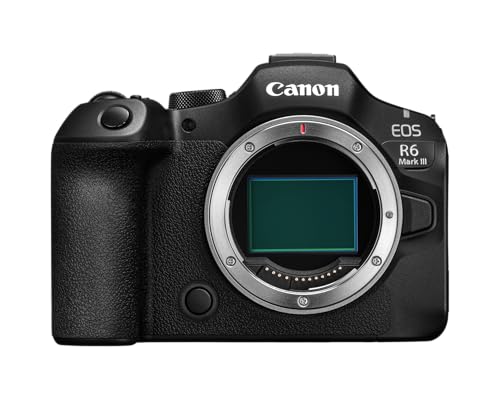
1. Canon EOS R6 Mark III (body only): Best Canon Camera for Photography Overall
We think this is the Canon most photographers should buy. It pairs a 32.5MP full-frame sensor with 40 fps bursts, sticky subject tracking and IBIS rated up to 8.5 stops, so one body covers birds, weddings and the family barbecue.
Picture herons on a lake at sunrise. Pre-capture keeps up to 20 frames from before you fully press the shutter, so you get the take-off you'd normally miss, and the buffer holds about 150 raws per burst. The grip is deep, the controls fall under your fingers, and twin slots take CFexpress Type B and SD cards. In a three-month check-in on RF Shooters, an owner moving up from the R6 Mark II says autofocus is clearly better and has seen no shutter faults.
But stills dynamic range trails Sony's a7 V, and 40 fps bursts drop to 12-bit files. So would we buy it? If you shoot a bit of everything, yes. If light weight matters more than speed, the R8 Mark II (#2) is the one to read next.

Best for: Enthusiasts who shoot wildlife, events and family and want Canon's best all-round full-frame photo camera

Skip it if: You want the lightest full-frame body for travel. The Canon EOS R8 Mark II (#2) is the better pick.
Pros
- 7K raw video and open gate recording in a mid-level body
- 40 fps bursts with a deep buffer (about 150 raws)
- Sticky, accurate subject tracking for wildlife and people
- 8.5-stop rated IBIS, strong for handheld shots
- Deep grip and well-placed controls
- Dual card slots, CFexpress B plus SD
Cons
- Dynamic range trails the Sony a7 V
- 40 fps electronic bursts drop to 12-bit
- Can overheat in long 4K60 takes
- Costs more than the R6 Mark II did
- EVF behind the Nikon Z6 III's
Hands-on reviews behind this pick
 Engadget
Show the verdict
Engadget names it the best midrange body for Canon video creators thanks to raw video, quick autofocus and handling, while noting its stills trail Sony's A7 V and it costs more than before.
- Tony & Chelsea Northrup
Show the verdict
Chelsea calls it a well-rounded camera that can do nearly anything: autofocus that locks on and stays on for wildlife and portraits, a buffer that seems endless, and great ergonomics.
2. Canon EOS R8 Mark II (body only): Best Canon Full-Frame Camera on a Budget
Here's the camera we'd point most first-time full-frame buyers to. The R8 Mark II keeps the light body of the original R8, then adds the two things it lacked: in-body stabilization and an AF joystick.
Say you're ten miles into a hike and the trail drops into a shaded canyon. The body barely registers on your strap, and IBIS rated up to 7.5 stops lets you shoot handheld at slow shutter speeds. Bursts run at 40 fps with pre-capture, and the buffer holds about 78 Raw+JPEG frames, roughly 30% more than the R8. Your old EF lenses work through Canon's adapter.
But the trade-off is stamina. Fred Miranda forum regulars, including a past R8 owner, keep pointing at the small LP-E17 battery and single SD slot, so pack a spare or a USB power bank. So is it enough camera? For hobbyists and travelers, yes. Shooting weddings for pay? The R6 Mark III (#1) gives you twin card slots.
Best for: First full-frame buyers and travelers who want light weight and IBIS in Canon RF
Skip it if: You shoot paid events and need a backup card slot. The Canon EOS R6 Mark III (#1) is the better pick.
Pros
- Adds in-body stabilization the original R8 lacked
- AF joystick returns for quick point selection
- 40 fps bursts with a bigger buffer than the R8
- Uncropped 4K60 oversampled from 6K
- Compact, light full-frame body
- Well-controlled rolling shutter
Cons
- Small battery, roughly an hour of video
- Only one SD card slot
- Small 2.36M-dot viewfinder
- Few third-party autofocus RF lenses
- Power/stills/video switch easy to overshoot
Hands-on reviews behind this pick
- DPReview
Show the verdict
DPReview calls it a remarkably capable camera for its class, with excellent image quality, added IBIS and a joystick, but battery life and a tightly controlled lens system keep it from top marks.
- Cameralabs
Show the verdict
Cameralabs highly recommends it as a strong mid-range pick that fixes the R8's gaps with IBIS and a joystick, but warns that discounted rivals with bigger batteries and sharper finders run it close.
- Jan Rybář
Show the verdict
Jan rates speed as its standout: 40 fps bursts with tracking that kept a leaping dog and moving birds sharp on a basic kit lens, making it an easy pick for budget-minded full-frame buyers.
3. Canon EOS R7: Best Canon APS-C Camera for Wildlife
So you want reach without a full-frame telephoto budget? The R7 is our pick. Its 32.5MP APS-C sensor crops in on your lens, and 15 fps mechanical bursts with sticky tracking kept roughly 90% of frames sharp on a moving cyclist. Canon hasn't announced an R7 Mark II, so this is still the current model.
Here's a typical morning: backyard birds at the feeder, shot from the kitchen window with an old EF telephoto on the adapter. IBIS steadies it even if that lens has no stabilizer, and the weather-sealed body, twin UHS-II slots and LP-E6NH battery mean a long morning outside doesn't end early.
One thing to know before you buy: early units showed shutter-shock blur with the mechanical shutter. Owners on the DPReview forums say firmware 1.3 fixed it, at the cost of slower bursts at some shutter speeds, and the electronic first curtain avoids it. The joystick also sits inside the dial, so expect a few accidental nudges at first. Is it the one for you? For wildlife on a budget, yes. Want lighter and cheaper for kids' sports? The R10 (#4) is the move.
Best for: Wildlife and sports shooters who want APS-C reach, IBIS and weather sealing, including DSLR owners with EF lenses
Skip it if: You want a lighter, cheaper body for kids' sports and don't need IBIS. The Canon EOS R10 (#4) is the better pick.
Pros
- 15 fps mechanical bursts with a deep buffer
- Reliable, sticky stills AF tracking with subject modes
- In-body stabilization that works with any lens
- Weather-sealed body with twin UHS-II card slots
- Detailed oversampled 4K and 10-bit C-Log 3
- Solid battery life from the larger LP-E6NH battery
Cons
- Heavy rolling shutter in oversampled 4K
- Joystick and dial combo causes accidental changes
- Low-resolution 2.36M-dot viewfinder
- Few native RF-S lenses; wide options are limited
- Video AF tracking drifts in low light
Hands-on reviews behind this pick
- DPReview
Show the verdict
DPReview rates the R7 one of the most well-rounded, versatile and capable APS-C mirrorless bodies, with fast bursts, sticky AF and IBIS, as long as the RF-S lenses you need exist.
- DPReview TV
Show the verdict
After a family trip shot only on the R7, DPReview TV calls it a capable hybrid with great AF and no overheating, held back by fiddly controls, a dim EVF spec and bad 4K rolling shutter.
4. Canon EOS R10: Best Cheap Canon Camera for Sports
Now, if the R7 is more camera than your budget wants, the R10 keeps the speed and drops the extras. It shoots 15 fps with the mechanical shutter, its stills tracking is quick and accurate, and it gives you two dials and a joystick, which the smaller R50 doesn't.
Say it's a Saturday Little League game and you're up in the bleachers. You fire a burst as the runner slides into second, and the mechanical shutter keeps the motion clean. The 23 fps electronic mode can warp fast action, so stick with 15. Battery life started near 200 shots and climbed toward 400 once settings were tuned, so bring a spare LP-E17.
But the catch is what's missing: no IBIS, no weather sealing and a smaller buffer. Launch-day owners on FM Forums praise the autofocus and the reach it gives with light lenses, while critics in the same thread call it overpriced without IBIS. For stills, we side with the owners. Need sealing and IBIS for wildlife? Step up to the R7 (#3).
Best for: Budget buyers shooting kids' sports and pets who want proper controls and fast bursts
Skip it if: You shoot outdoors in all weather or want IBIS. The Canon EOS R7 (#3) is the better pick.
Pros
- 15 fps mechanical bursts for action on a budget
- Accurate, reliable stills AF tracking
- Beginner friendly but with full manual control
- Twin dials and a joystick, unlike the R50
- Sharp oversampled 4K 30p from the full width
- Menus split stills and video settings
Cons
- No in-body stabilization
- Significant rolling shutter in full-width 4K
- Video AF tracking is unreliable
- Short battery life from the small LP-E17
- No weather sealing and few native RF-S lenses
Hands-on reviews behind this pick
- DPReview
Show the verdict
After months with it, DPReview calls the R10 a beginner-friendly camera with real manual control, good images and reliable stills AF, well worth carrying over a phone, but weaker for video work.
- Tony & Chelsea Northrup
Show the verdict
The Northrups shot portraits, golf and wildlife and rate the R10 the best fast-action option at its price thanks to 15 fps mechanical bursts, while the kit lenses and slow-motion audio let it down.
5. Canon EOS R1 (body only): Best Canon Camera for Pro Sports Shooters
But what if photos are your job? Then the R1 is Canon's flagship for a reason. Its stacked sensor reads out very fast, it shoots 40 fps raw with up to 20 frames of pre-capture, and its sports-aware tracking follows the action.
Think about the rail at a horse race in steady rain. The weather-sealed body handles the downpour, and the buffer keeps up all the way down the home stretch without locking you out. The 9.44M-dot viewfinder is superb, and Ethernet plus twin CFexpress Type B slots suit fast filing. The box has the LP-E19 battery and charger; cards are extra.
Here's the catch for everyone else: it's a specialist. 24MP limits cropping, the integrated grip makes it big at 1,115 g, and setup is complex. Firmware has been a hassle too, and owners on the DPReview forums now wait before updating after Canon suspended a release in July 2025. Shooting everything, not just sports? The R6 Mark III (#1) is the better all-rounder.
Best for: Professional sports, action and news photographers who need top speed in harsh conditions
Skip it if: You shoot a mix of subjects and want a lighter body with more resolution. The Canon EOS R6 Mark III (#1) is the better pick.
Pros
- 40 fps raw bursts with a huge buffer
- Very fast stacked sensor readout
- Tough, weather-sealed body that handles well
- Superb 9.44M-dot viewfinder
- Strong video: 6K RAW, oversampled 4K, C-Log 2
- Pre-capture for stills and video
Cons
- 24MP is low for landscape or studio work
- Large, heavy integrated-grip body
- Steep learning curve with many controls
- No waveform display for video
- Early firmware updates had bugs and a pulled release
Hands-on reviews behind this pick
- DPReview
Show the verdict
DPReview's early hands-on sees a tough 1-series body that shoots like an R3, with faster readout, cross-type AF and smart sports tracking, but notes burst speed trails rivals and no waveform.
- PetaPixel
Show the verdict
PetaPixel calls the R1 a superb, rugged specialist for sports and news with great AF, a bottomless buffer and 40 fps raw, but says that focus makes it a weaker all-rounder than a Z8 or Z9.
- Fstoppers
Show the verdict
Fstoppers relays an owner's wildlife verdict: clean oversampled 4K, strong C-Log 2 range, pre-record and excellent animal AF give flagship video, though missing waveforms and auto subject mode irk.
6. Canon EOS R50: Best Small Canon Camera for Travel Photos
Want a real camera that still fits in a small bag? That's the R50. It's one of the smallest interchangeable-lens bodies around, yet its Dual Pixel AF locks onto people and most animals' eyes, and you get a viewfinder, a vari-angle touchscreen and a flash.
Say you're on a family road trip. The camera rides in the glovebox, and at each overlook you pull it out, frame the sunset in the viewfinder and let eye AF handle your kids. JPEGs start smearing fine detail above ISO 3200, though, so golden hour at the beach suits it better than a dim diner. Expect about 370 shots per charge, and pack a spare LP-E17.
So the real limit is glass. Early R50 owners on the DPReview forums say the slow kit lens and thin RF-S range hold it back indoors, and one returned it for that reason. Budget for a faster lens if you shoot inside. Need more buttons and faster bursts? The R10 (#4) is the step up.
Best for: Travelers and smartphone upgraders who want better photos from a very small, light Canon
Skip it if: You shoot fast action and want twin dials and longer bursts. The Canon EOS R10 (#4) is the better pick.
Pros
- Very small and light at 375g with battery and card
- Strong AF that sticks to people and animals
- Sharp uncropped 4K 30p
- Vari-angle touchscreen plus a viewfinder
- Good photo quality and Canon color
- Built-in flash for low light
Cons
- Small buffer limits long bursts
- Rolling shutter when panning in 4K
- One control dial and cramped rear buttons
- Weak battery life from the small LP-E17
- No IBIS and a soft 18-45mm kit lens
Hands-on reviews behind this pick
- Engadget
Show the verdict
Engadget's Steve Dent finds the R50 strikes a good balance of power and affordability for a hybrid that handles most jobs, though content creators may be better served by Sony's ZV-E10.
- DPReview
Show the verdict
DPReview calls the R50 a very capable compact camera that delivers where it counts, photo quality and AF, with full-width 4K, though tight controls, the kit lens and rolling shutter hold it back.
7. Canon EOS R100 (RF-S 18-45mm kit): Best Cheap Canon Camera for Beginners
Here's the thing about the R100: the corners Canon cut are in handling, not image quality. Its 24.1MP sensor takes photos on par with pricier 24MP bodies, and Dual Pixel AF with face and eye detection is dependable for family shots.
Imagine portraits of your grandparents on the porch. You chat, they relax, and eye AF stays on them without you touching anything. The kit comes with the RF-S 18-45mm lens, battery and charger, and there's a mic input and a hot shoe if you grow into flash.
But the screen is fixed and not touch, so moving the AF point means a four-way pad. An owner on the DPReview forums says mapping a button for AF area makes up for that, and other owners repeat the touchscreen and burst complaints. Bursts slow to about 3.5 fps with continuous AF. Our take: for stills on the tightest budget, it's a fair buy. If you can stretch, the R50 (#6) is the better long-term buy.
Best for: Beginners who mainly shoot portraits, family and travel photos and want Canon RF for the lowest cost
Skip it if: You want a touchscreen and smoother handling. The Canon EOS R50 (#6) is the better pick.
Pros
- Cheapest way into Canon's RF mirrorless system
- Very good photo quality from the 24MP sensor
- Light, compact body at about 356 g
- Quick Dual Pixel AF with face and eye detection
- Mic input and a full hot shoe
- Strong battery life for its class
Cons
- Fixed rear screen with no touch control
- 4K is heavily cropped and uses slower contrast AF
- Only about 3.5 fps with continuous AF
- Small raw buffer fills in about a second and a half
- No in-body stabilization
- Few native RF-S lenses, no fast normal prime
Hands-on reviews behind this pick
- DPReview
Show the verdict
DPReview finds the R100 takes very good photos and is the cheapest RF entry, but says dated parts, a non-touch screen and weak cropped 4K add up to too many compromises to recommend it.
- Cameralabs
Show the verdict
Cameralabs says the R100 does what it sets out to do: a simple, light step up from a phone with good photos and Dual Pixel AF, though enthusiasts will find the R50 the better buy.
- PetaPixel
Show the verdict
PetaPixel likes the sensor, eye AF and quiet shutter, but calls the handling clunky and the missing touchscreen a big miss, and thinks the R50 is the better long-term buy for most.
8. Canon PowerShot G7 X Mark III: Best Pocket Canon Camera for Photos
So what if you'd rather not carry a lens at all? The G7 X Mark III is the pocket answer. A 1-inch stacked sensor sits behind a 24-100mm equivalent zoom that opens to f/1.8, and that bright lens is the reason to buy it.
Say you're at dinner and the restaurant is lit by candles. It slides out of your pocket, you open up to f/1.8, and the shot of the table keeps its mood. The flip touchscreen helps with group selfies, and the ND filter lets you shoot wide open in sun. Battery life is short at about 265 shots, so charge over USB or carry a spare NB-13L.
But video is the weak spot. A 2019 DPReview thread collects owners who returned it over 4K overheating and hunting video autofocus, though some owners never hit the problem. For stills, it holds up. New stock is also scarce and often marked up. Want a bigger sensor and a viewfinder in a small body? The R50 (#6) is our pick.
Best for: Travelers who want a pocket camera that beats a phone for stills, with manual control when they want it
Skip it if: You want a viewfinder and a bigger sensor in a small body. The Canon EOS R50 (#6) is the better pick.
Pros
- Truly pocketable with a bright f/1.8-2.8 zoom
- Uncropped 4K plus 120p slow motion
- Mic input and live streaming for vloggers
- Selfie-flip touchscreen
- Built-in 3-stop ND filter
- Fast 20 fps bursts and 30 fps raw burst
Cons
- Overheats in long 4K clips
- Contrast-only AF hunts in video
- No viewfinder
- Short battery life, about 265 shots
- Heavy JPEG noise reduction
Hands-on reviews behind this pick
- Photography Blog
Show the verdict
Photography Blog says this is no minor refresh: the stacked sensor, fast bursts and strong video kit make it one of Canon's best compacts for stills and vlogging, despite no viewfinder.
- MPB
Show the verdict
MPB's travel test finds a lovely pocket stills camera with great photos and handy ND filter, but says 4K overheating and unreliable video AF stop it from being the vlogging camera its fame suggests.
9. Canon EOS Rebel T7 (EF-S 18-55mm IS II kit): Best Canon DSLR Camera for Learning
Now, is a Canon DSLR still worth buying? For one kind of buyer, yes. The Rebel T7 is Canon's entry-level DSLR, and its simple controls, optical viewfinder and good 24MP raw files make it an easy way to learn photography.
Take a beginner photo class. You learn shutter speed and aperture through the viewfinder, and when a classmate hands you an old EF portrait lens, it just fits. The battery lasts about 500 CIPA shots through the viewfinder, so a full day out is fine, and Wi-Fi sends photos to your phone.
But the age shows. Live view focusing is very slow, about 1.2 seconds of lag in Photo Review's measurements, and the 9-point AF struggles with action. A year-long owner on the DPReview forums calls it great for beginners but suggests a used R50 for a little more, and other owners repeat the slow live view complaint. Should you buy one? Only for stills on a tight budget. For the same buyer, the R100 (#7) is the mirrorless pick.
Best for: Stills-first learners on a tight budget who want an optical viewfinder and cheap used EF lenses
Skip it if: You want faster focus and a camera you won't outgrow. The Canon EOS R100 (#7) is the better pick.
Pros
- Easy for beginners with simple controls and auto modes
- Good 24MP stills and 14-bit raw files
- Optical viewfinder with long battery life
- Huge range of EF and EF-S lenses
- Wi-Fi for sending photos to a phone
Cons
- Very slow live view autofocus
- Only 9 AF points and 3 fps bursts
- No mic input and no 4K
- Fixed, non-touch screen
- Viewfinder crops about 5% of the frame
Hands-on reviews behind this pick
- Photo Review
Show the verdict
Photo Review finds a compact, easy DSLR with accurate color and good raw detail that beats a phone, but calls it unexciting, with erratic AF and slow live view, and suggests mirrorless instead.
- Potato Jet
Show the verdict
Potato Jet calls the T7 an awesome gateway for learning photography that delivers good shots with a nice lens and holds resale value, but says video buyers should skip it for a T7i or similar.
Best Canon cameras for photography buying guide for 2027
Full frame or APS-C: which Canon camera is right for your photos?
Pick full frame if dim rooms and clean high-ISO shots matter most, and APS-C if you want reach and a lighter bill. A full-frame sensor, like the ones in the R6 Mark III and R8 Mark II, is bigger and gathers more light, which is why our picks for indoor receptions are full frame. An APS-C sensor, in the R7, R10, R50 and R100, crops in on your lens, so a telephoto acts longer for birds and field sports.
So match the sensor to your subject. Weddings, indoor events and night streets lean full frame. Backyard birds and kids' soccer lean APS-C, and the R7 is our pick there. Need the most detail to crop? The R6 Mark III and R7 top this list at 32.5MP. One trap: RF-S lenses are made for APS-C, and the native range is thin, especially wide angles. If you're still deciding on a brand, start with the top cameras from every brand.
Which Canon cameras have in-body image stabilization?
On this list, the R6 Mark III, R8 Mark II, R7 and R1 have in-body stabilization, and the R10, R50, R100 and Rebel T7 don't. IBIS moves the sensor to cancel your hand shake, so a slow shutter speed in a dim church stays sharp with any lens, including adapted EF glass without its own stabilizer. Canon claims up to 8.5 stops at the center for the R6 Mark III and up to 7.5 for the R8 Mark II.
Without IBIS, you rely on stabilization in the lens. The kit lenses for the R100 and Rebel T7 have it, which is fine for daylight and fast shutter speeds. But if you plan to adapt old unstabilized EF lenses, or shoot handheld at night, buy a body with IBIS. The G7 X Mark III uses optical stabilization in its fixed lens.
How much do RF lenses add to the cost of a Canon camera?
More than most of you plan for, because the body is only the start. Canon keeps the RF system tightly controlled, with few third-party autofocus lenses, so you'll mostly buy Canon glass. And native RF-S lenses for the APS-C bodies are few.
So plan your budget around the lens you need, not just the body. A kit like the R6 Mark III with an RF24-105mm, or the R7 with the RF-S 18-150mm, covers a lot in one zoom. For the R50, owners say the slow 18-45mm kit lens is the real limit indoors, so set money aside for a faster lens. And if cash is tight, your cheapest route is lenses you already own, which brings us to adapters.
Can you use EF lenses on a Canon RF camera with an adapter?
Yes. The R6 Mark III, R8 Mark II, R7, R10, R50 and R100 all take EF lenses through Canon's adapter, so your old Rebel lenses don't have to sit in a drawer. Pair them with a body that has IBIS, like the R7 or R8 Mark II, and even older lenses without their own stabilizer get steadied.
The Rebel T7 works the other way round: it's a DSLR, so EF and EF-S lenses mount directly, and used ones are cheap. That makes it a fair choice if a relative is handing down a bag of lenses. If you're starting from zero and want to compare mirrorless systems too, see our picks of beginner cameras from Canon, Nikon, Sony and Fujifilm.
How fast does a Canon camera need to shoot for sports and wildlife?
For most kids' sports and backyard birds, 15 fps with reliable tracking is plenty, and the buffer matters as much as the speed. The R10 and R7 both reach 15 fps with the mechanical shutter, and the R7's deeper buffer keeps going longer. The R6 Mark III and R8 Mark II hit 40 fps with pre-capture, which saves frames from before you fully press the shutter, handy when a bird takes off without warning.
At the top, the R1 shoots 40 fps raw with a buffer that rarely fills, built for pros. Be careful with electronic shutters on cheaper bodies: the R10's 23 fps mode can warp fast motion. The R100 and Rebel T7, at about 3 to 3.5 fps, aren't built for action. Just want simple snapshots instead? Browse pocket cameras under $200 for casual snaps.
Best Canon cameras for photography: frequently asked questions
What is the best Canon camera for photography?
For most of you, it's the EOS R6 Mark III: a 32.5MP full-frame sensor, 40 fps bursts with pre-capture, sticky tracking and IBIS rated up to 8.5 stops. Want lighter, cheaper full frame? Get the R8 Mark II. For wildlife on APS-C, the R7 is our pick.
Which Canon camera is best for beginners?
Get the EOS R100 if you mainly shoot family and portraits and want the cheapest RF body, since its photos match pricier 24MP models. If you can spend a bit more, the R50 adds a vari-angle touchscreen and easier handling. Learning on a DSLR? The Rebel T7 still works.
Can I use my EF lenses on a Canon mirrorless camera?
Yes. Canon's adapter mounts EF lenses on its RF bodies, including the R6 Mark III, R8 Mark II, R7, R10, R50 and R100. Pair them with the R7 or R8 Mark II, and in-body stabilization steadies even older lenses that lack their own.
Is a Canon DSLR still worth buying?
Only for a stills learner on a tight budget. The Rebel T7 is easy to use, lasts about 500 shots per charge through the viewfinder and takes cheap used EF lenses. But live view focus is very slow and it has just 9 AF points, so most beginners are better off with the R100 or R50.
Which Canon camera is best for wildlife and sports?
For most hobbyists, the EOS R7: APS-C reach, 15 fps mechanical bursts with a deep buffer, IBIS and weather sealing. On a tighter budget, the R10 keeps the speed but drops IBIS. Want full frame with pre-capture? Get the R6 Mark III. Shooting pro sports in the rain? The R1.